Showing posts with label Brad Thor. Show all posts

Sunday, September 18, 2022

Brad Thor bibliography: 'Takedown'


Mr. Thor breaks the previously established "Star Trek" pattern by delivering a fifth entry that is actually quite solid in a lot of respects.

Once again, Harvath has to stop some Islamic terrorists.  It's a little sad to see the same group take center stage, but what can you do?  Oddly enough, there's no mention of the vampire virus, the intra-faith coup or the play for world domination from the previous book.   This group has their own objective, and they are quite determined to carry it out.

The first order of business is to blow up all the bridges and tunnels leading in and out of Manhattan.  This early portion of the book was where it really shined.  Thor was in the zone here as the passages describing the ensuing chaos and fear were as gripping and intense as the situation needed them to be. Even though this is one of those rare sequels that de-escalates, it still felt fairly big in scope.

The fact that Harvath is brought together with a full team of former military soldiers to tackle the problem, rather than partnering up with just one capable female, also lends credence to the idea that this is a "big one" in the Harvath-verse. 

Sadly, the book can't carry the momentum.  There is a noticeable drop in steam once you get past those portions.  It's not bad, but it doesn't have the same pop as what came before.

The characters themselves don't have too much opportunity to distinguish themselves.  Harvath was having lunch with an old friend when things started to go down and their banter helps him a little.  The female soldier also gets a memorable scene where she helps Harvath get off of a booby-trapped chair that was wired to explosives.   The others just kind of blend into the background and tag along to provide extra firepower.

One thing that holds this book back is the politics.  This is very "early war on terror" stuff and it does age it a bit.  It was a bit of a problem in this book's predecessor, but it remains here.  There is quite an emphasis on "enhanced interrogation".  

While the book does largely hue towards the "these terrorists are evil, lives are in danger and we don't have time to beat around the bush to get the information we need" both in terms of character dialogue and even the prose itself, the book actually does what a lot of writers can't seem to do and allows the opposing perspective to make valid points.  There's even one point where the terrorists themselves are aghast and disgusted by what one of the interrogators put the captive terrorist through after they find him.  I don't know if it hits the level of "thought provoking", but it at least put in the effort.

This is also the book that introduces the popular recurring character known as "the Troll".  He plays a bit part here, but he is given a clear motivation and he does leave an impression. At one point, it seems like the book is going to paint him as a future adversary to Harvath, which would have been interesting, though it was undercut by the fact that I've read later books and know that he lives and isn't an enemy.  The book itself shows that the two are moving closer to better terms, so it's a brief concept.

This book also marks the first use of a legitimate cliffhanger ending. The book does a great job of making you drop your guard before it happens too.  Harvath gets a house, finds new love, and even gets a puppy!  Then bam! A thing happens.  Won't spoil it, though the dog gets out OK from what I can tell, so that's good.  We don't know who's behind it, but it says an assassin from Harvath's past.  Now, it's quite possible that it's an assassin we've never seen before.  This series has done that, but I do like the idea of a returning enemy from one of the previous books making a play for revenge.  I guess I'll just have to dive into "The First Commandment" to see what all the hubbub is. 


Click here to open an E-Trade account

Click here to open a RobinHood account

Click here to become a Swagbucks member

Click here to open a FundRise account

Sunday, April 24, 2022

Brad Thor Bibliography: 'Blowback'


It seems that Mr. Thor is adhering to the old "Star Trek" movie rule, where the even numbered entries are the superior.  

Honestly, this one probably tops the list and ranks as my favorite so far.  It's the most gripping entry, has the most complex plot, and even veers into incorporating science and history.  There are times where it almost feels like a genre shift.  In any event, it still works, as Harvath has to race to stop hostile parties from releasing an ancient, deadly virus.

Said virus is freaky as heck.  The scene when we're first introduced to it is a major highlight of the book.  The vampire parallels and the fact that it apparently targets specific groups almost gives it an otherworldy feel.  Sure, Thor's a "fact"ion guy, so there's a more mundane explanation and you know that that is going to be the case from the get-go, but it is still freaking creepy when it's playing out.  

This is obviously the most researched book.  As noted, it ties in both science (in regards to the virus itself) and history (Hannibal's endeavors play a pretty critical role in the plot.)  It can lead to some heavy exposition dumps, but I think that the payoff was worth it.

The story also has a lot of moving parts.  It all connects to some extent, but this is definitely the most elaborate of Thor's tomes.  It also leads to the story having the biggest scope, which is impressive considering what went down in previous books.

Really, the only weak link was the Harvath video.  Early on, he is caught assaulting someone he thinks is a terrorist.  Turns out, it wasn't and the video goes public.  It puts him in political hot water, but the narrative is very quick to absolve him of any wrong doing.  Sure, he's the hero, but at the same time, there was some potential for introspection and growth.  It gets to the point that when people bring up what happened, he just gets pissy and defensive.  It's a missed opportunity, really.

The terrorist himself is a formidable adversary.  The book tries to paint him as a sort of nemesis and the results are mixed.  As was the case with "Path of the Assassin", he and Harvath cross paths a few times with the terrorist gaining the upper hand more than once.  Unfortunately, a lot of their history has to be glossed over so the whole "nemesis" thing doesn't work as well as one would hope.  The book is already pretty thick, so there really wasn't much more that could be done, but it is what it is.

Meg Cassidy is brushed off.  Really, the fact that she held out as long as she did is kind of impressive.  Her plot does cast a shadow, though, as Harvath directly compares what he's doing with this book's partner to how he pulled Meg into the conflict.  Granted, the lady here was being directly targeted, but still. 

She works out well, she's an expert on viruses, so she is able to pull her weight and provide insight into matters that are well outside of Harvath's usual wheelhouse.  There's no attempt at a romance, which some might appreciate.  Speaking of, I did like how Harvath's ally from "Lions" made a quick appearance to provide some assistance.

It seems like Thor has hit his stride.  Will the momentum carry, or will book V be Harvath's "Final Frontier"?


Click here to open an E-Trade account

Click here to open a RobinHood account

Click here to become a Swagbucks member

Click here to become an E-Poll member

Sunday, April 18, 2021

Brad Thor Bibliography: 'State of the Union'

 I had a hard time getting into this book.  I don't know why, exactly.  It isn't like "Lions", where the writing was clunky and stilted.  A part of it is just a busy schedule, which isn't helped by the fact that the longer you go without picking up a book, the harder it is to pick back up.  Still, this one didn't grab me the way I had hoped it would.

The book does have an interesting premise: "what if the Soviet Union didn't really collapse, but instead, rolled over and played dead until the time was right to strike".  It's certainly big in scope, but alas the book doesn't really do too much with it.  The idea is touched on once or twice, but it's almost an afterthought.  To be fair, we can't really expect Harvath to take down an entire superpower by himself.  At the same time, having him focus on finding nukes and dismantling a "Star Wars" style missile defense system isn't really what we were sold.  It's not bad, but I feel like this could have been a more epic entry than the 24-style outing that we got.

The book attempts to flesh out Harvath, with him reflecting about his relationship with his father.  It does give some more details about his history, but it doesn't really connect with the plot.  It's more like something that acts as bookends.  It's well intentioned, but again, the book doesn't do enough with it.

Meg Cassidy sits this one out for the most part.  I was certain that their relationship was going to end, but while there are tensions due to Harvath's job and commitment to said job, the two are still together by book's end, albeit attempting a long distance relationship.  It does buck the trend of having the female love interests cycle out book to book.  Still, it would have been cool to see her play a bigger role in the plot.  I don't know how much longer she'll be sticking around, but we'll see.

We do still get a new female partner to team up with Harvath.  This one doesn't turn out to be a love interest, though.  She doesn't even really meet Scot up until the last third of the book.  It was surprising, but it worked.  She has her own goals and reasons for stopping the villain du jour that aren't really tied to Harvath or even the well being of the United States. When all is said and done, she just goes home.  It was a good breaking of the expected formula.  

This read was very sporadic.  It got to the point where I actually considered starting over again.  I opted against it, though, because I'm behind schedule enough as it is.  Still, though, I do want to give this a re-read at some point.  I don't think this run through gave it a fair shake.  I know that, much like with George R.R. Martin's "Song of Ice and Fire" books, Thor fans will read through the entire chronology more than once.  I don't know if I'll go that far; I still have to finish this read-through.  On top of that, there are plenty of other books on my to-read pile.  Still, I wouldn't mind taking another crack at this one some time down the line.

The book ends with Harvath getting a new mission.  Had more specifics been dropped it could have been a cool sequel hook/segue to the next book: Blowback.  As it is, I think the intent was more for a general "and the adventure continues" type thing.  Either way works, really, though I think I would be more partial to the first option.  Maybe the prior does turn out to be the case, I guess I'll just have to see


Saturday, July 11, 2020

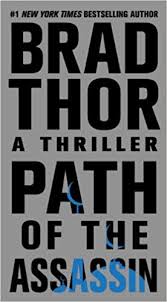
Brad Thor Bibliography: 'Path of the Assassin'

In a "behind the scenes" video, Brad Thor brings up the notion that the hardest book for an author to write isn't the first, but the second.  He ascribes this to fear of what is known as the "sophomore slump", where an author's second entry just doesn't live up to what the first delivered.  Considering how "meh", I came away from his initial outing, "Lions of Lucerne", the idea of a slump did not entice me.

Thankfully, Thor's efforts to avert the trope paid off in spades, as this is a marked improvement over what came before.

The writing is stronger and tighter, the plot is more complex, and the stakes feel higher.  Even the villains feel more capable.  The Lions were a solid concept, but lacked in execution.  Here, we see the titular assassin confront Harvath a few times and actually get the drop on him more than once.  There's more tension as a result and it makes for a much more engaging read.

Harvath himself is also better depicted.  He still butts heads with superiors, but the fact that they're from other departments helps.  Sure, that's been done before too, but it still worked better.  He's also more in line with how he is in the latter half of "Lions", where his schmuckish tendencies became more subdued.  Really, the only scene where he came off as unlikable to me was when he accosted a CIA courier for no discernible reason.  The biggest problem I had with him here was the fact that a lot of his smart-aleck remarks weren't particularly funny.  He has a couple, but a lot of them fall flat; which is made worse by the fact that surrounding characters all react as if he's really pulling them off.

Harvath is joined by a new female compatriot.  His partner/love interest from "Lions" is sent off to make way for her.  Thankfully, while there is some flirtation/attraction, the two don't necessarily become a thing.  The book does end with Harvath thinking that he intends to keep her in his life, but it's a bit more ambiguous.  I think it works better this way.  If Harvath is going to have a rotating cast of sidekicks, it's better that they don't all become love interests.  It would get repetitive really quickly and harder to buy later on down the line.

There was a point where said character actually harbored a grudge against Scot and vowed never to trust him again.  They make amends later, but a part of me actually wanted to see the two part on bad terms.  It would have been an interesting subversion of the usual formula.  Maybe that'll happen later, who knows?

Normally, I'd say just skip the first book and jump right to this one.  Unfortunately, the plot of this one really does pick up where the first book left off.  The events play a much bigger role in what happens here than I expected.  In some ways, it's a good thing.  The events of each book matter and there is a building continuity.  On the other hand, I found "Lions" underwhelming, and having this be more self contained could have worked to its advantage as a stand alone thriller.

Still, this was a fun read.  I think it does a much better job showing off Thor's talents as an author and I'm definitely more excited to progress through the series now than I was after the first book.


Click here to become a Swagbucks member

Thursday, January 16, 2020

Brad Thor Bibliography: 'The Lions of Lucerne'

For quite a while now, I have wanted to do a deep dive in to author Brad Thor's library.  I've read a couple of his books in the past and found them generally enjoyable: fast paced and hard to put down.  

I was pretty excited to go back to the beginning of this particular franchise, but alas, this one doesn't get off to the most auspicious start.  This is Thor's first novel and you can tell this is the case by a lot of factors.

The plot itself is very stock, "the president's been kidnapped, is Scot Harvath a bad enough dude to rescue him?"  Spoiler alert, the answer is yes. 

This flaw is augmented by simple prose which spends a lot of time telling us more than it shows us.  The narration references character traits that aren't really seen and, in particular, the book has a habit of explaining dialogue.  Now, this is helpful when characters are using military jargon, but it still feels clunky.  The worst example is when a character references people getting fired over a debacle by saying that "Henry the VIII would be taking new wives" i.e. heads are going to roll.  The line itself would have been fine, but the book stops to explain the historical reference even though it's pretty common knowledge. 

I also rolled my eyes at all the scenes where Harvath is chewed out by his superior for being a loose cannon who isn't following protocol and that he's being taken off the case.  It's something we've seen a thousand times and it's done with no sense of irony or self awareness. 

Speaking of Harvath, the introduction for the character itself is a bit on the rocky side.  I liked his rapport with the First Daughter.  It was only showcased in the early chapters, but it was one of the highlights of the book.  Later on, though, he kind of turns into a tool.  I've read other Harvath books and never really suffered that problem, so it caught me off guard in all honesty.  They try to chalk it up to the fact that he has a concussion, but it doesn't really endear you to the character.

Thankfully, both Harvath and the book get better in the second half.  You can tell that Thor is finding his groove, as the latter half features more of the action and fast pace that you would expect from the author.  Harvath himself also becomes far more likable, making it that much easier to keep reading.   

Having Harvath get implicated in the nefarious misdeeds also works to the book's benefit.  It changes up the narrative a bit and escalates the tension.  Not only does the time frame shrink, but it renders Harvath without the resources he would have had a few chapters prior. 

Oddly enough, this book took me a while to get through.  Other Thor books were much breezier reads.  Now, part of this might just be due to me having a busy schedule, but I still think that his later books have a much stronger pull to them.

On the plus side, this book is devoid of the flaws that would plague Thor's later books.  There aren't entire chapters dedicated to a character pontificating on a current event issue.  Harvath is also depicted more realistically and less of the "Gary Stu" that he is often described as later on in the saga.  He does some impressive things here and there, but it doesn't come off as unbelievable.  He also suffers lasting consequences from physical injuries, which subverts most action hero depictions.

Will this book have you hooked?  Well, it has others, but it didn't really have that effect on me.  I'm still going to follow through and read the remaining books in Thor's library, but if this were my first exposure to the author, I don't think I'd be all that impressed.  I didn't hate it by any stretch, but it wasn't the most mind-blowing opening to a franchise.

I think you're better off reading a couple of Thor's later books and then coming back and reading this.  The introduction to Harvath is more interesting if you know about a couple of his later exploits, as you can see where it all started.  Going into this blind might not end up working.  The book does have its strong points, but the flaws are also quite easily noticed.


Click here to become a Swagbucks member